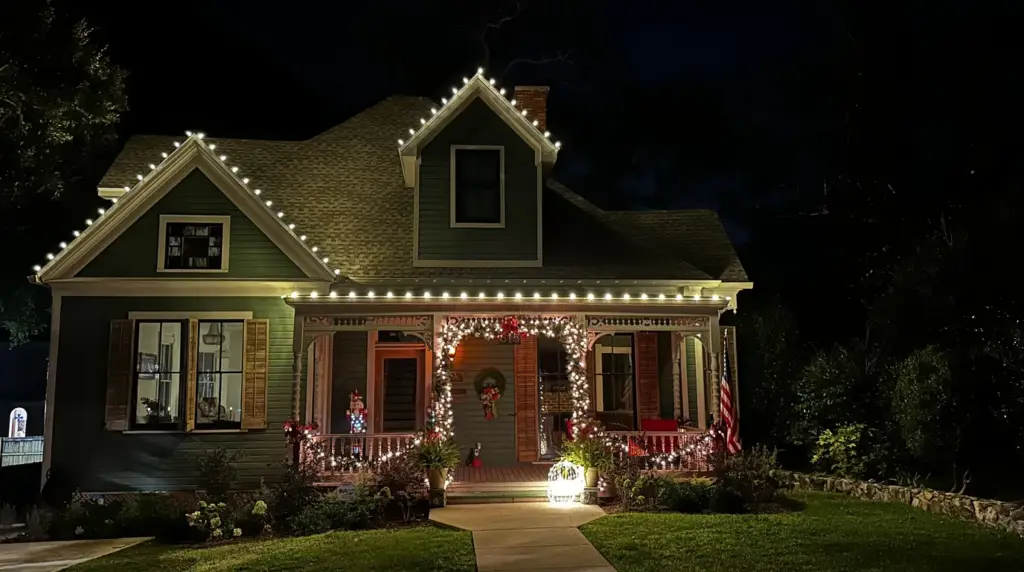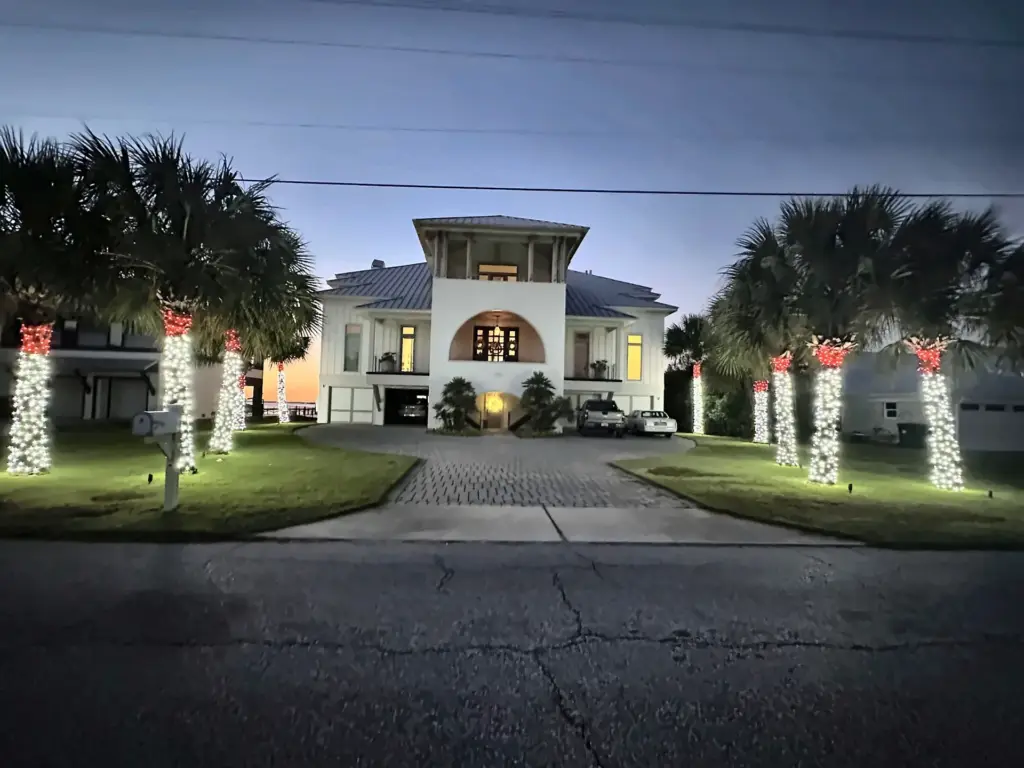

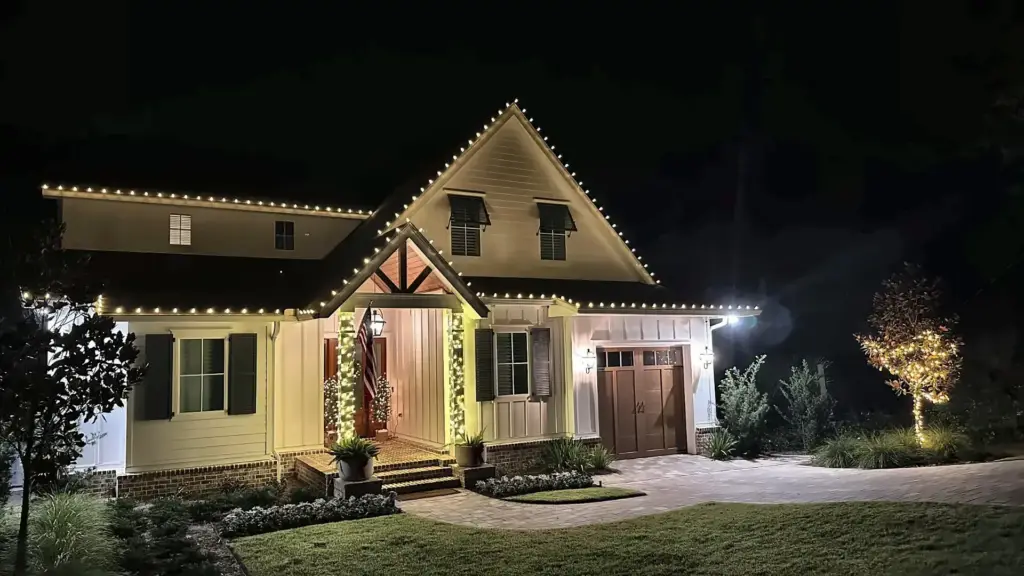
In this guide
Light a House Your Way
Pick a house, a bulb and a color, then add extras. The drawing changes as you go, and the price list uses our published starting prices.
Christmas Light Designer
A drawing, not a photo. Your free design preview uses a real picture of your home.
C7 vs. C9 Bulbs: Which Goes Where
The "C" means a cone-shaped bulb. The number is usually read as its width in eighths of an inch, so a C7 is about 7/8 inch across and a C9 about 1 1/8 inches. Measured product specs match that. One retailer reads the number as the base size instead, but either way the bulbs and sockets don't swap: C7 bulbs use a small E12 base and C9 bulbs use a larger E17 base.
| Item | C9 | C7 |
|---|---|---|
| Width | About 1 1/8 in. | About 7/8 in. |
| Length (incandescent) | About 2.9 in. | About 2.1 in. |
| Base | E17 (intermediate) | E12 (candelabra) |
| Power, LED | About 0.5 to 0.8 W | About 0.5 to 0.6 W |
| Power, incandescent | 7 to 10 W | 5 to 7 W |
| Best for | Rooflines, peaks, large trees, anything seen from the street | Windows, doors, railings, small trees, close-up detail |
A simple test from one retailer: if your neighbors across the street should see each bulb as a distinct dot, use C9. Up close, on a porch railing or a front window, C9s can look oversized, which is where C7s fit.
The other bulbs you'll see
- 5mm wide-angle minis. A cone-shaped lens about the size of a pencil eraser that throws light in every direction. Installers use them almost exclusively on trees, palms and shrubs.
- M5 minis. An LED version of the old faceted "rice" mini. They look like traditional minis, which is why many people prefer them indoors.
- Globe bulbs (G40, G50). Round bulbs named for their width in millimeters, so a G40 is about 1.5 inches. They look best spaced 12 inches or more apart on rooflines and patios.
- Faceted vs. smooth. Faceted lenses sparkle and look traditional. Smooth lenses look modern. They put out the same light, but a faceted lens can shift the color slightly, so don't mix the two on one line.
Warm White vs. Cool White
White lights are sold by color temperature, measured in Kelvin (K). Lower numbers look golden, like old incandescent bulbs. Higher numbers look bright white or slightly blue. The catch is that brands don't agree on the names.
| Source | Warm white | Pure white | Cool white |
|---|---|---|---|
| Christmas Designers | 2,500 to 3,200K | 4,000 to 5,500K | 6,000 to 7,000K |
| Christmas Light Emporium | About 3,000K | About 4,600K | About 6,400K |
| Minleon product specs | 2,600 to 2,800K | 7,000 to 9,000K | Not listed |
Minleon's "pure white" is what other brands call cool white. Read the Kelvin number on the box, not the name.
Match the white to your house
| Your exterior | White that usually works |
|---|---|
| Red or brown brick | Warm white |
| Cream, tan or beige siding | Warm white |
| Light stucco | Cool white roofline, pure white minis |
| Stone or metal | Cool white outline |
| Mixed materials, modern style | Pure white roofline |
From one retailer's color guide. Use it as a starting point; your free design preview shows both on your actual house.
Never alternate two different whites bulb by bulb, and buy enough for a whole area at once, because batches vary. If you're adding LEDs next to old incandescent strings, choose warm white; pure white looks blue beside them.
Color Schemes That Work
These are the patterns installers screw in bulb by bulb along a roofline. Each one repeats in the order shown.
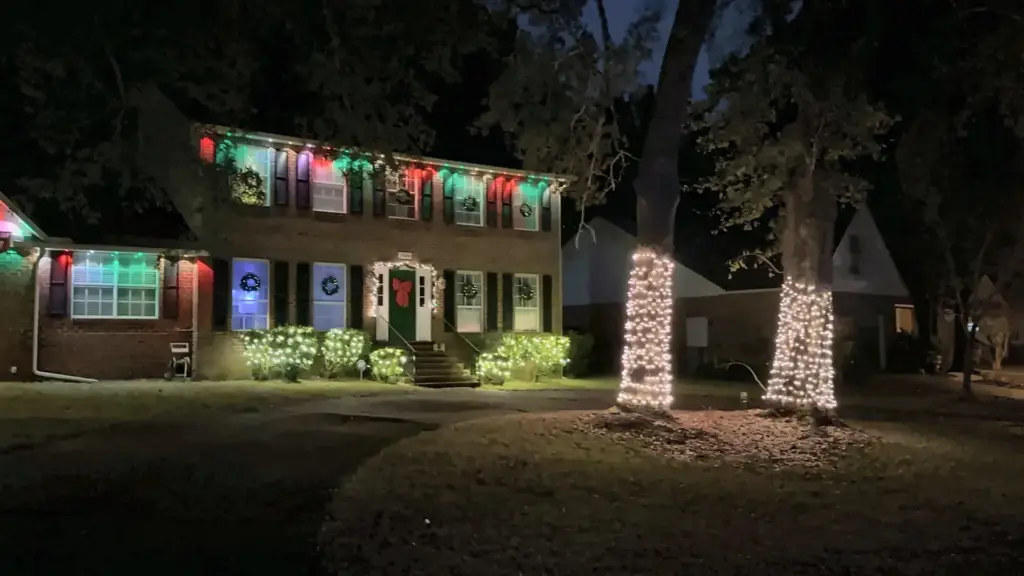
Classic multicolor
Red, blue, green, orange, gold. The nostalgic look, and the favorite in one retailer's survey.
Candy cane
Red and warm white, every other bulb. Bold from the street.
Cool white and blue
A crisp, wintry look that suits white and gray homes.
Red, green and gold
Traditional Christmas colors without blue.
Champagne
Three shades of white for a soft, layered glow.
Coastal
Aqua, blue and white. Our pick for waterfront and beach homes; it pairs well with lit palms.
Want purple, green and gold for Mardi Gras after Christmas? See the color ideas in our palm tree lights guide, or consider permanent lights that change color for every holiday.
Ideas by House Type
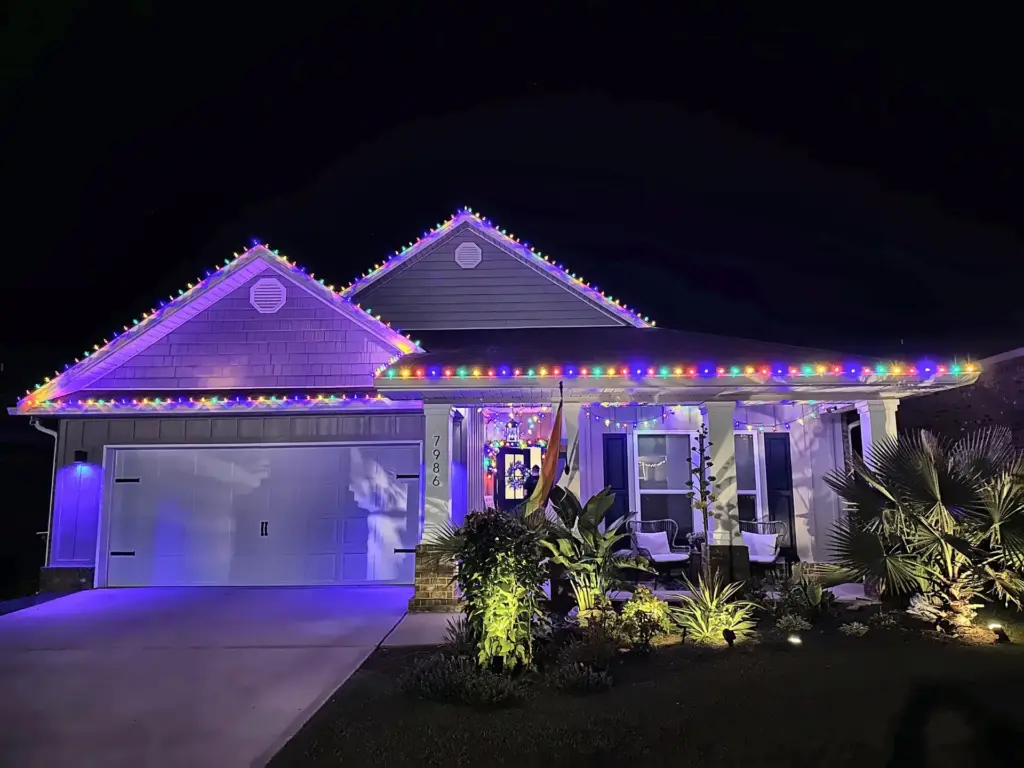
One-story ranch
On a long, low eave, adding more lights to that one line won't make the house look bigger. Installers add height instead.
- Pick one strong roofline and light it well. Step windows and posts down to smaller bulbs.
- Add height with a wrapped tree or palm, placed off-center about a third of the way across the yard.
- Don't outline the garage door panels. Outline the fascia above it, flank the door, or hang one wreath sized to it.
- Layer from the street: path lights near the curb, the tallest element in the middle, and net lights on the foundation shrubs.
Two-story
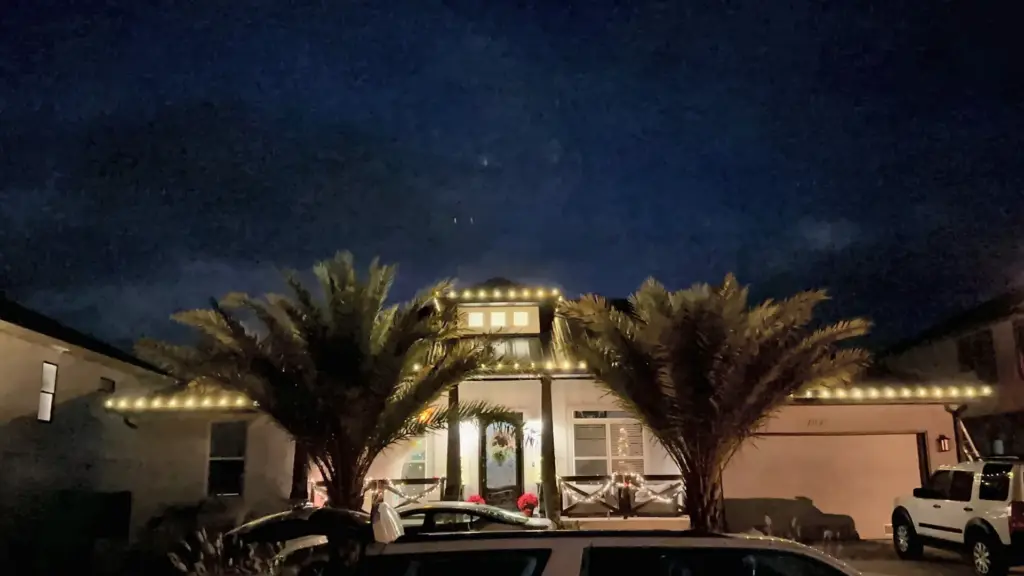
- Think in three bands: the upper roofline, the porch or first-floor line, and the ground. Make the top brightest and let the ground anchor it.
- Don't leave the middle dark. A lit porch line or front windows keep it from looking like two separate displays.
- Wrap tree trunks 8 to 10 feet up so the yard reaches toward the roof.
- Use 12- to 15-inch spacing on high rooflines. Second-story work usually costs more because of the ladder or lift time.
Raised coastal or beach home
You'll see homes on pilings all over Pensacola Beach, Perdido Key and Navarre. The living space starts a floor up, so the roofline sits high and the ground level often stays dark.
- Light the deck or porch railing with C7s to connect the roof and the ground.
- Outline the stairs, which guests use at night anyway.
- Use the coastal palette or cool white with blue, which suits light siding and metal roofs.
- Expect more salt exposure. See the notes on connectors and bulbs below.
Design Rules Installers Use
- Point every bulb the same way. Upright on the roof edge, all at the same angle.
- Put a bulb on every corner and center one on each peak. Start each gable at the peak so any leftover spacing ends at the bottom corners, where nobody notices.
- Use one spacing across the whole house. 12 inches is the standard. At about 18 inches a roofline reads as a dotted line instead of a ribbon.
- Outline only the front-facing windows and the entry. Outlining every opening looks busy.
- Match the house and the landscape. The same color or white on both ties the display together.
- Step back to the curb after each addition. Spread light unevenly on purpose, with one clear focal point.
- Measure, then add 10%. Retailers suggest adding 5 to 15% to your measured roofline for corners and runs to the outlet.
Gulf Coast Notes
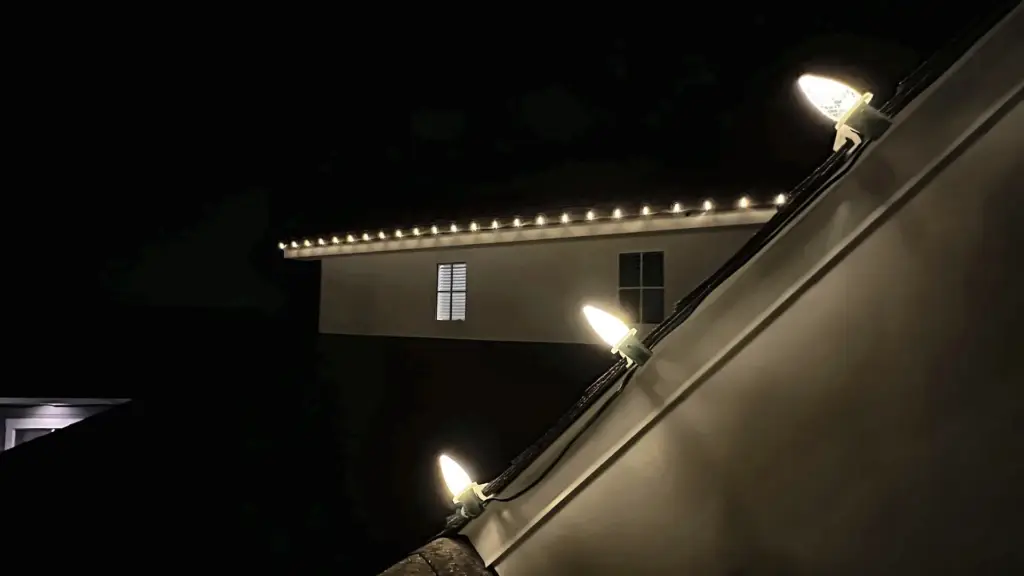
- Salt air is hard on lights. Sockets and bulb bases rust, and cord insulation wears faster near salt water. A thin coat of bulb grease slows it but doesn't stop it.
- Choose sealed, separate parts. Commercial sets with screw-on (coaxial) connectors keep water out, and separate bulbs and cord let you replace only what fails. On a sealed retrofit bulb, one failure doesn't take out the whole string.
- Check the water rating. Commercial LED C9s are sold at IP65 (Minleon) and IP67 (Wintergreen OptiCore). Water ratings don't measure salt corrosion, which is why coastal installs still wear faster.
- One clip per socket. It keeps the line crisp and holds better in wind. No clip maker publishes a wind rating.
- Never staple a palm. Palms can't heal trunk wounds. Our palm tree guide shows the safe way.
Power and How Many Strings to Connect
LEDs changed the math. An LED C9 uses under 1 watt, while an incandescent C9 uses about 7. ENERGY STAR says certified LED light strings use about 70% less energy and stay cool to the touch.
| Bulb | Incandescent | LED |
|---|---|---|
| C9 | 7 to 10 W | About 0.5 to 0.8 W |
| C7 | 5 to 7 W | About 0.5 to 0.6 W |
| Mini | About 0.4 W | About 0.07 W |
How many strings you can link end to end depends on the set, so follow the label. As a rough guide, retailers list 2 to 3 incandescent C9 strings against 20 to 87 LED strings, and 4 to 5 incandescent mini sets against 40 or more LED sets. A standard 15-amp household circuit should carry no more than about 1,440 watts, which is 80% of its rating.
Running costs are small with LEDs. Our cost guide works out a full season at a few dollars.
Frequently Asked Questions
What is the difference between C7 and C9 Christmas lights?
Size and use. A C9 bulb is about 1 1/8 inches across with an E17 base, and is made for rooflines and anything seen from the street. A C7 is about 7/8 inch across with a smaller E12 base, and suits windows, doors, railings and small trees. The bases don't fit each other's sockets.
Should I use warm white or cool white Christmas lights?
Warm white (about 2,500K to 3,200K) looks golden and suits brick, tan and cream homes. Cool white (about 6,000K and up) looks bright and slightly blue, and suits gray, white, stone and metal exteriors. Use one white per area, and check the Kelvin number on the box because brands name their whites differently.
How far apart should Christmas lights be on a roofline?
12 inches is the standard spacing for C9 and C7 bulbs on a house roofline. Some installers use 15 inches on very long runs. Keep one spacing across the whole house.
What Christmas lights look best on a one-story house?
One strong roofline in C9 bulbs, plus height from a wrapped tree or palm placed off-center, and net lights on the shrubs. Avoid outlining the garage door panels; light the fascia above it or hang one wreath instead.
Can you mix warm white and multicolor lights?
Yes, by area. A common look is a warm white roofline with multicolor trees or bushes, or the reverse. Avoid mixing two different whites in one line.
Are LED Christmas lights worth it?
For outdoor displays, yes. LED C9 bulbs use under 1 watt each against about 7 watts for incandescent, run cool, and allow far more strings on one circuit. Commercial LED sets also come sealed against water.
See These Ideas on Your Own House
Send a photo or your address. We'll text back a picture of your home lit the way you like, with a price for every part. Free, with no obligation to book. Or see everything included with our Christmas light installation in Pensacola.
Sources
- Christmas Lights Etc, C7 and C9 bulbs, watts and amps and UL standards for light strings
- 1000Bulbs, C7 vs. C9 Christmas lights and C7 product specs
- Bulbs.com, incandescent C9 specs
- Christmas Light Source, Minleon C9 and C7 specs, faceted vs. smooth bulbs, design guide and salt and lights
- Wintergreen OptiCore C9 specs
- Christmas Designers, white color temperatures, 5mm vs. M5 lights and retrofit vs. stringer sets
- The Christmas Light Emporium: warm, pure and cool white, roofline color patterns, roofline and gable layout, one-story homes and two-story homes
- 1000Bulbs holiday lighting survey (retailer survey of 1,000 Americans)
- ENERGY STAR, decorative light strings
- Angi, cool white vs. warm white Christmas lights
- Creative Displays, holiday lighting in coastal cities
Most sources are lighting retailers and installers, and their figures vary. Where they disagree, this guide gives the range. We review it each fall.